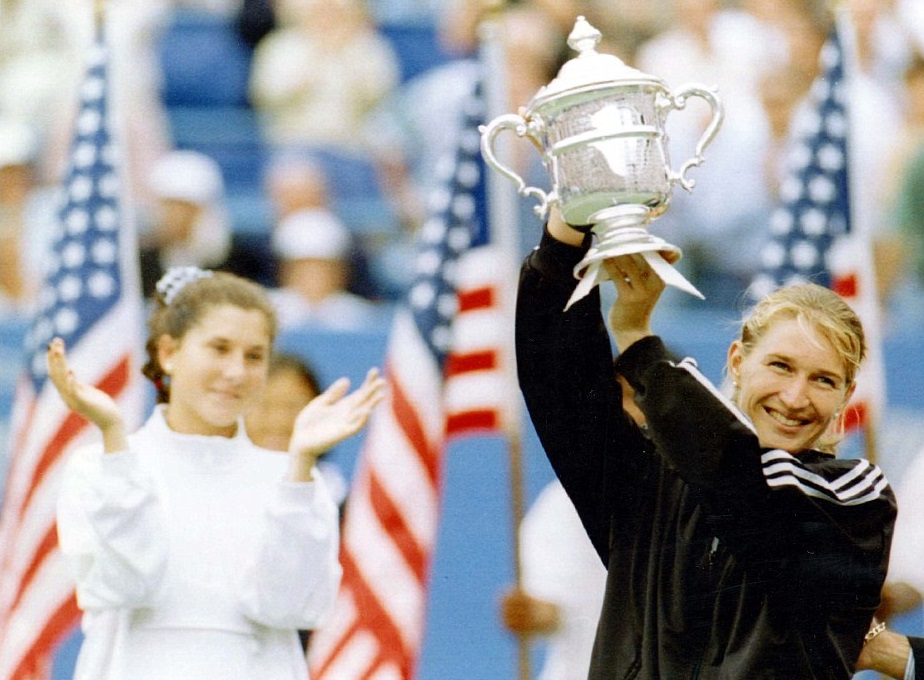
Photo credit: Reuters / Graf hoists the '95 U.S. Open trophy as Seles looks on.
The story of Steffi Graf and Monica Seles is a complicated tale: a rivalry that promised to challenge Navratilova-Evert as one of the all-time duels, but failed to sustain the feverish pace of its first four years. I was shocked to discover that Steffi and Monica played each other only 15 times during their careers. If you think of women’s tennis between 1990 (Seles’ first Grand Slam) and 1999 (Graf’s retirement), these are the two women who commanded the public consciousness. Both dominated the tour for extended periods and were unquestionably the top two players by a wide margin. But, due to a pair of two-year stretches, one tragic and the other injury riddled, their rivalry never blossomed into what it ought to have been.
Graf’s 22 Grand Slam singles titles dwarf Monica’s 9, and so it should be no surprise that Steffi holds a 10-5 advantage in their head-to-head. Makes sense, right? But this is the problem with assessing Seles’ place in tennis history: we can only speculate as to what she might have accomplished had her career not been interrupted. Consider too that the infamous stabbing was perpetrated by a Graf fanatic who sought to curtail Monica’s stranglehold on the game, one which she had successfully wrested from Steffi. Between 1991 and 1993, Seles won 8 of the 11 Slams she contested, a staggering return by anyone’s standard. She was at the absolute peak of her powers; none, including Graf, had answers for a blistering game that had transformed women’s tennis.
Although Monica was without question the number one player during that span, Steffi still led their head-to-head up to 1993. The trouble for Graf was that Seles had been winning when it mattered most. Between 1990 and 1993, they met in 4 Slam finals with Monica winning 3, the only respite for Steffi coming on the lawns of Wimbledon in 1992. This is where their story turns tragic. For those who are unfamiliar with what transpired in Hamburg on April 30, 1993, this is a good starting point.
The first tennis match I ever watched was the 1994 Wimbledon final between Martina Navratilova and Conchita Martinez. I had no idea who Monica Seles was, nor did I have any context for the gaping hole her absence from the tour created. As far as I knew, Steffi Graf and Arantxa Sanchez-Vicario were the top players. I was immediately drawn toward the Barcelona Bumblebee as the constant underdog clawing at Steffi’s throne. As for Monica, she was a foreign entity to me, an asterisk in the rankings; I knew nothing of the player she was prior to leaving the tour. Monica’s return in the summer of 1995, and her immediate success, was a stirring moment for the tour. I immediately thrust my support behind Seles to avenge Steffi’s many beatings of Arantxa.
Graf’s 22 Grand Slam singles titles dwarf Monica’s 9, and so it should be no surprise that Steffi holds a 10-5 advantage in their head-to-head. Makes sense, right? But this is the problem with assessing Seles’ place in tennis history: we can only speculate as to what she might have accomplished had her career not been interrupted. Consider too that the infamous stabbing was perpetrated by a Graf fanatic who sought to curtail Monica’s stranglehold on the game, one which she had successfully wrested from Steffi. Between 1991 and 1993, Seles won 8 of the 11 Slams she contested, a staggering return by anyone’s standard. She was at the absolute peak of her powers; none, including Graf, had answers for a blistering game that had transformed women’s tennis.
Although Monica was without question the number one player during that span, Steffi still led their head-to-head up to 1993. The trouble for Graf was that Seles had been winning when it mattered most. Between 1990 and 1993, they met in 4 Slam finals with Monica winning 3, the only respite for Steffi coming on the lawns of Wimbledon in 1992. This is where their story turns tragic. For those who are unfamiliar with what transpired in Hamburg on April 30, 1993, this is a good starting point.
The first tennis match I ever watched was the 1994 Wimbledon final between Martina Navratilova and Conchita Martinez. I had no idea who Monica Seles was, nor did I have any context for the gaping hole her absence from the tour created. As far as I knew, Steffi Graf and Arantxa Sanchez-Vicario were the top players. I was immediately drawn toward the Barcelona Bumblebee as the constant underdog clawing at Steffi’s throne. As for Monica, she was a foreign entity to me, an asterisk in the rankings; I knew nothing of the player she was prior to leaving the tour. Monica’s return in the summer of 1995, and her immediate success, was a stirring moment for the tour. I immediately thrust my support behind Seles to avenge Steffi’s many beatings of Arantxa.
Seles made a triumphant return to the WTA at the 1995 Canadian Open. She followed that with a run to the U.S Open final, galvanizing support from Americans who were attuned to her story; she was an underdog for the first time in her career. That Seles would meet Graf in that final only added to the drama of the match. Consider too, for some tennis fans, Graf was now the villain; the stabbing was carried out in her name. All these factors resulted in a mouth-watering final, which Steffi won in three sets. Still, Seles was back, and her victory at the subsequent Australian Open in 1996 appeared to breathe new life into a once stalled rivalry.
Watch Monica Seles reflect on 1993 and the 1995 U.S. Open final against Graf.
Watch Monica Seles reflect on 1993 and the 1995 U.S. Open final against Graf.
After Seles’ comeback in 1995, she managed a further four Slam finals, with that solitary win at the ’96 Australian Open. Simply put, she was never quite the same player. A very good player, but nowhere near the dominant force that blitzed the tour in the early ’90s. Meanwhile, Steffi was in the twilight of her career. Between 1997 and 1999, she missed four Grand Slams and countless months due to injury. The window had closed for the two to reignite their rivalry. They played five times after Seles’ return with Graf winning all but one encounter, the 1999 Australian Open quarter-final, after Steffi had missed the previous Wimbledon and U.S. Open.
Who’s the best comparison we can make to Monica’s still excellent second career? Mary Pierce (2 Slams, 6 finals, 14 QFs) or Jana Novotna (1 Slam, 4 finals, 22 QFs)? Neither woman advanced to the final 8 with the same regularity as Monica. Between 1995 and 2003, Seles reached 20 Grand Slam quarterfinals from 26 attempts. That’s a staggering level of consistency for which most current players would sell their souls. Consider that Kim Clijsters reached 19 quarterfinals in her entire career. While Seles didn’t win as much upon her return, she still had plenty of game, which was reflected in her results.
Due to one crazed man’s overzealousness, Monica Seles suffered a physical and mental ordeal that changed her life and tennis history. Sport fans never got to see the Graf/Seles rivalry play out organically, one which promised so much but yielded a measly 15 meetings. The stabbing in Germany also altered the discourse surrounding both players’ careers. Monica – who was robbed of the chance to become one of the all-time greats – became an irresistible darling of tennis fan. Meanwhile, Steffi will always have her record questioned by fans and pundits. How do her 22 Slams hold up against Serena’s 17, when Seles might have lopped a few off Graf’s tally? Perhaps Steffi may have made adjustments to thwart Seles at her peak, winning everything anyway. But, now we will never know; Steffi’s legacy will always have that cloud hanging over it. Aside from their individual suffering, the biggest shame is that tennis fans and tennis history were cheated of something truly special.
This is the second in a series on great tennis rivalries:
The Sisters Williams: Beyond Tennis Rivalry.
Who’s the best comparison we can make to Monica’s still excellent second career? Mary Pierce (2 Slams, 6 finals, 14 QFs) or Jana Novotna (1 Slam, 4 finals, 22 QFs)? Neither woman advanced to the final 8 with the same regularity as Monica. Between 1995 and 2003, Seles reached 20 Grand Slam quarterfinals from 26 attempts. That’s a staggering level of consistency for which most current players would sell their souls. Consider that Kim Clijsters reached 19 quarterfinals in her entire career. While Seles didn’t win as much upon her return, she still had plenty of game, which was reflected in her results.
Due to one crazed man’s overzealousness, Monica Seles suffered a physical and mental ordeal that changed her life and tennis history. Sport fans never got to see the Graf/Seles rivalry play out organically, one which promised so much but yielded a measly 15 meetings. The stabbing in Germany also altered the discourse surrounding both players’ careers. Monica – who was robbed of the chance to become one of the all-time greats – became an irresistible darling of tennis fan. Meanwhile, Steffi will always have her record questioned by fans and pundits. How do her 22 Slams hold up against Serena’s 17, when Seles might have lopped a few off Graf’s tally? Perhaps Steffi may have made adjustments to thwart Seles at her peak, winning everything anyway. But, now we will never know; Steffi’s legacy will always have that cloud hanging over it. Aside from their individual suffering, the biggest shame is that tennis fans and tennis history were cheated of something truly special.
This is the second in a series on great tennis rivalries:
The Sisters Williams: Beyond Tennis Rivalry.
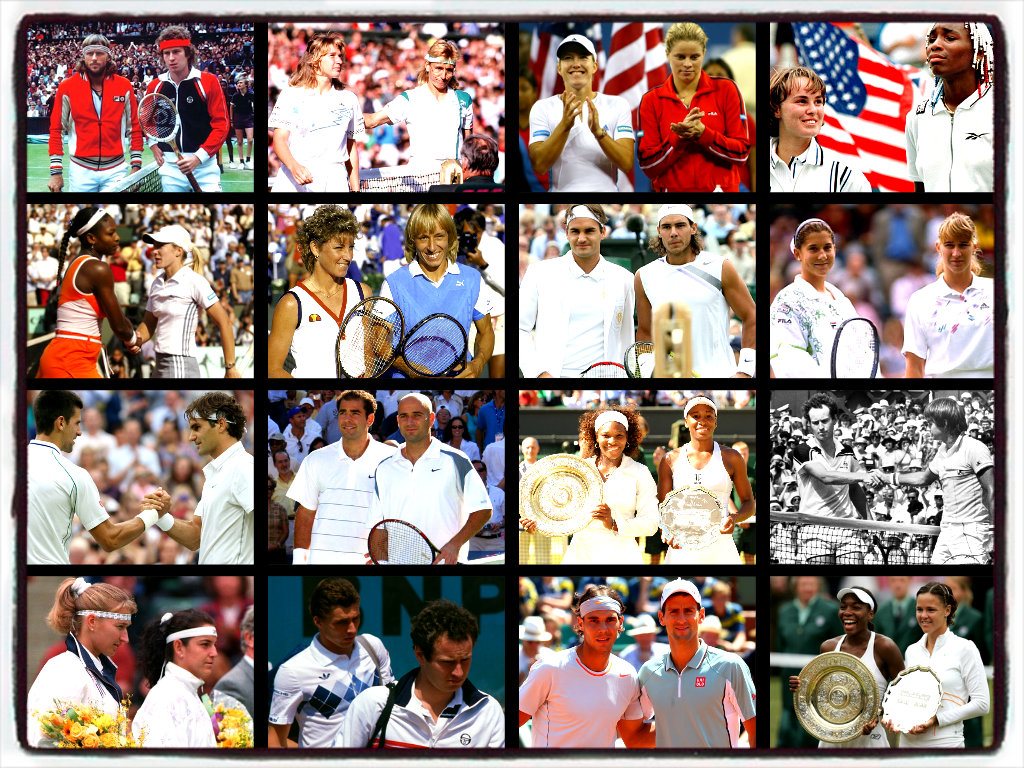
Up Next: Pete Sampras & Andre Agassi.
 RSS Feed
