Sport Scribe
  • Home
  • Selected Writing
  • The Body Serve Tennis Podcast
  • Contact
  • #ThisWeekInTennis

THE BODY SERVE TENNIS PODCAST: Scandal, Upsets & Your Least Favorite CommieS

1/23/2016

0 Comments

 
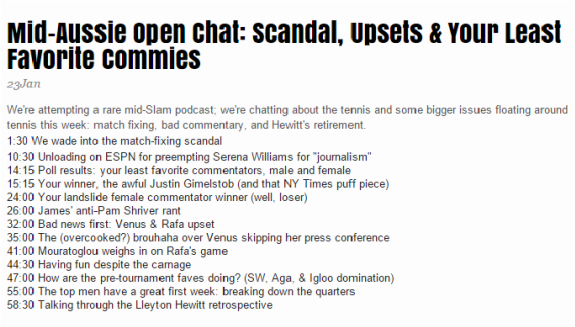
Jonathan and James return to discuss a wild opening week of the 2016 Australian Open. The first few rounds featured upsets galore, a match-fixing scandal and a slew of entertaining matches. We also report the findings of our (very scientific) Twitter polls asking our listeners to tell us who their least favorite tennis commentators are. As always, we look forward to yourfeedback, and give us a review on iTunes if you like what you hear!
Picture
0 Comments

THIS WEEK IN TENNIS: WEEK ONE OF 2016 AUSTRALIAN OPEN

1/23/2016

0 Comments

 
The 2016 Australian Open began under the cloud of a BBC/Buzzfeed report alleging match-fixing in tennis. The chaos surrounding the story was matched on court by a slew of upsets, particularly in the women's draw. By the completion of the second round, only 14 of the 32 seeded women remained in the draw. The men's seeds experienced a less turbulent time of it in Melbourne, with only seven failing to advance to the third round. Week one will also be remembered for the final match of Lleyton Hewitt's career. The long-time Aussie stalwart lost to David Ferrer in the second round, in his 20th appearance at the Australian Open. 
Embed from Getty Images


​WTA


UPSETS​
Round One

Zhang Shuai d. (2) S. Halep 6-4 6-3
J. Konta d. (8) V. Williams 6-4 6-2
Y. Putintseva d. (16) C. Wozniacki 1-6 7-6 6-4
M. Gasparyan d. (17) S. Errani 1-6 7-5 6-1
E. Kulichkova d. (22) A. Petkovic 7-5 6-4
Q. Wang d. (24) S. Stephens 6-3 6-3 
K. Pliskova d. (25) S. Stosur 6-4 7-6
L. Davis d. (26) A. Pavlyuchenkova 1-6 6-3 6-4
D. Kasatkina d. (27) A. Schmiedlova 6-3 6-3
J. Larsson d. (29) I. Begu 6-3 6-2 
P. Cetkovska d. (30) S. Lisicki 6-4 6-4 
V. Lepchenko d. (31) L. Tsurenko 6-7 6-2 6-3 
B. Strycova d. (32) C. Garcia 6-2 6-4  ​
​Round Two 

D. Gavrilova d. (6) P. Kvitova 
A. Beck d. (11) T. Bacsinszky 6-2 6-3 
N. Osaka d. (18) E. Svitolina 6-4 6-4 
L. Siegemund d. (19) J. Jankovic 3-6 7-6 6-4 
K. Bondarenko d. (23) S. Kuznetsova 6-1 7-5 

Round Three


B. Strycova d. (3) G. Muguruza 6-3 6-2
(21) E. Makarova d. (9) K. Pliskova 6-3 6-2
A. Friedsam d. (13) R. Vinci 0-6 6-4 6-4
D. Gavrilova d. (28) K. Mladenovic 6-4 4-6 11-9

​Check out who's left in the WOMEN'S DRAW
​
​SPOTLIGHT

Zhang Shuai 

The Chinese player, ranked as high as #30 in 2014, scored one of the biggest upsets of the first week when she dismissed #2 seed Simona Halep in straight sets. Compounding the loss for Halep was the fact that Zhang had failed to advance past the first round of a Slam in each of her previous 14 attempts, and lost in qualifying at Slams a further 13 times. Yet, the world #133 summoned her best tennis, and finds herself in the fourth round, where she will play Madison Keys on Monday. 


Naomi Osaka

In just her third attempt at qualifying for a Grand Slam main draw, Osaka made it all the way to the third round before losing to a resurgent Victoria Azarenka. She will leave Melbourne with yet another career high ranking, having announced herself as a player to watch for the 2016 season and beyond. Osaka beat Donna Vekic in the first round and then #18 seed Elina Svitolina in straight sets two days later. 

OTHER STANDOUTS
​
  • Daria Gavrilova - Into her first-ever fourth round at a Slam after taking out Hradecka, Kvitova, and Mladenovic. A new career high awaits her at tournament's end, cracking the top 30 should she win two more matches.
  • Victoria Azarenka - She's making minced meat of her opponents so far, dropping only five games in three matches. Kerber is a potential quarterfinal opponent.
  • Serena Williams - The world #1's form through three matches has been a revelation: she's yet to drop a set while turning back Giorgi, Hsieh, and Kasatkina with aplomb. The path to a 22nd Slam title gets harder with Sharapova, Radwanksa, and Azarenka her likely opponents in the final three rounds.


​PRESS

​
​Q. Off topic, a lot of Europeans learn how to speak English and not very many Americans learn to speak another language. You have. How has learning French helped you? What do you advise for other players and other people?
SERENA WILLIAMS: It's amazing how you meet a 14 or 13 year old and they are speaking three languages. You're, like, How is that possible?
That was really encouraging for me when I first came on tour to really focus and to really try to get fluent and to really try to get really good at French.
So it worked out. One of my dreams was to give my speech in French. I'm working on English now. (Laughter.) 


Q. One of the top players in the world; won two Grand Slams. What are your...
NAOMI OSAKA: (Laughter.) I never feel pressure from playing someone that's supposed to be like better than me, sort of. I'm just going to go in there happy and hopefully try to pull off an upset.

Q. You said after the match when you first saw the draw and saw you were playing Venus you were hoping just to be out there for an hour. What do you think of her age and coming back at her age and having the great year she had last year?
JOHANNA KONTA: I think it would be silly to look at Venus' age and somehow consider that as a reflection of her level. I think it's irrelevant how old she is because she's such a champion with so much experience and so much knowledge about the game.
Even if she's playing with one leg out there, you've got to really take care of things on your own, because, yeah, no, she's an incredible player. I have all the respect for her in the world. Yeah, I was just very, really enjoying my time out there.


Q. Venus has been fined for not attending press yesterday. Is there a reason she didn't come?
SERENA WILLIAMS: I don't know. If you want to, you can ask her. Yeah, I don't know. I wasn't here. In fact, I was watching Telenovela. I'm coming apart, though. Do we have any more questions?

Q. Your biography will come out next year. Have you started to think about it and talked to people about helping you writing the book?
MARIA SHARAPOVA: I have started writing the book.
Q. By yourself?
MARIA SHARAPOVA: Yeah, I'm working with a writer, and I'm writing myself. Yeah, I think that's one of the reasons it will take a little bit longer because I want to write a lot of it myself. I'm working with Rich Cohen, who is a tremendous writer. He's kind of a fly-on-the-wall guy, very discreet, incredible writing.
I was in New York working with him for a little bit after Fed Cup. He came up in my off-season to work together a little bit. So, yeah, I have started. Going to take my time. Not going to talk about it much just because I want the book to do the talking. But I'm really excited about it.
I've always loved to write. Something that's been a passion of mine from a young age. I'll also be sharing some of my journals as a young girl.


Q. How much on your mind was the fact you never won a match before at a Grand Slam in the main draw?
ZHANG SHUAI: Actually I already forget how many time because so many time before everybody tell me this is 10 time. Next time for sure you win. But already, like, I don't know how many time already. So doesn't matter.
I just try my best, yeah.


Q. How do you think you're going to be remembered as a tennis player?
SAMANTHA STOSUR: Well, hopefully not from my Australian Open results (smiling).
I've had a really good career. I've achieved a lot of things. You know, winning a Grand Slam was my dream from when I was eight or nine years old, and I've been able to do that. There's been a lot of good in my career.
But I'd obviously like to do better here at the Open.


​Q. What happened today?
CAROLINE WOZNIACKI: I would say it's a pretty shitty start to the season. It wasn't a pretty first set but I got it done and really should have closed it off in two.

You know, I let her back into the match, and it was basically my own fault that I'm not here as the winner.


Q. How does it feel to be one of the last of your generation? There's Federer and not many else - and Venus.
SERENA WILLIAMS: You know, there's a few of us. I'm waiting on Roger, waiting on his next move (smiling).

Q. Your profile will be growing. Are people starting to recognize you or are you having to slip around Coles?
DARIA GAVRILOVA: I went to the gym today just to have a bit of a stretch. The person recognized, and I was like, Oh, cool.

Q. Talk on the tour has been about your form. Do you think on the back of these couple of matches that you are "the" player or one of "the" players to beat?
VICTORIA AZARENKA: Irrelevant. Sorry. I mean, I know I always answer the same way, but it's really how I feel. You know, the talk is just opinions. It's not facts. I say that you always have to go out there and you have to prove yourself and you have to play and you have to win, you know, to keep those opinions the same way.

Q. Some players prefer to try and take a break to make sure an injury is gone. Do you think you're going to need to do that at any point or you're confident the injury's behind you?
SIMONA HALEP: I did. I had a break when I felt pain at this Achilles after Singapore, and before, as well. But now was like came straightaway after I arrived in Brisbane. When I went off of the plane I felt the pain and I couldn't walk anymore.
I'm okay. I don't believe that I need break, but I will take few days I need mentally, and then I will start working hard again because is just a tournament and I have many more ahead.


Read More
0 Comments

THIS WEEK IN TENNIS: THE HAPPY SLAM AWAITS (1/11 - 1/17)

1/16/2016

0 Comments

 
After an eventful opening week to the 2016 tennis season, chock full of big-name stars, week two was a much more low key affair. The biggest name in action this week was WTA #2, Simona Halep, still dealing with lingering Achilles/leg problems. On the men's side, David Ferrer at #8 was the top ranked player on the circuit. Nonetheless, there was plenty on offer to delight tennis fans: a resurgent Svetlana Kuznetsova, an improved Bouchard, Fast 4 Tennis, a Troicki defence, and 32 qualifiers who battled their way into the main draw of the Australian Open. While we're on the topic, be sure to check out my preview of The Happy Slam!
ATP
Embed from Getty Images


​Week 2 Winners
​
  • Sydney - Victor Troicki d. Grigor Dimitrov 2-6 6-1 7-6 (That's back-to-back Sydney titles for Troicki)
  • Auckland - Roberto Bautista Agut d. Jack Sock 6-1 1-0 retired. (The Spaniard's triumph in Auckland was the third ATP title of his career.)

Spotlight​

​Once dubbed "Baby Fed" for the uncanny similarities to Roger Federer in style of play, Grigor Dimitrov now finds himself struggling to stay afloat inside the ATP top 30. From a career high of #8 in August 2014, Dimitrov now resides at #28 after a disastrous 2015 season, when he advanced to the final eight only six times. However, his quarterfinal showing in Brisbane and run to the finals in Sydney promise to spark a comeback of sorts for the beleaguered Bulgarian. Both losses -- to Federer in Brisbane, and Troicki in Sydney -- were in three sets. Along the way, he scored wins against: Troicki (Brisbane), Simon, Cuevas, Dolgopolov, and Muller. While his name won't be mentioned as a favourite in Melbourne, Dimitrov is at least able to carry some momentum into the rest of the season as he begins the climb back to the ATP top 10.

Other Standouts
  • Jack Sock - F, Auckland (d. Estrella Burgos, Pospisil, Anderson, Ferrer)
  • Jo-Wilfried Tsonga -  SF, Auckland (d. Kohlschreiber, Fognini)
  • Taylor Fritz - Qualified for Australian Open main draw (d. Moriya, Berrer, Zverev)
  • Tim Smyczek - Qualified for Australian Open main draw (d. Pereira, Karatsev, De Schepper)
​
Other events this week: Kooyong Classic, Fast4 Tennis, ​Australian Open Qualifying

Read More
0 Comments

THE BODY SERVE TENNIS PODCAST: RETURN OF THE HAPPY SLAM

1/15/2016

0 Comments

 
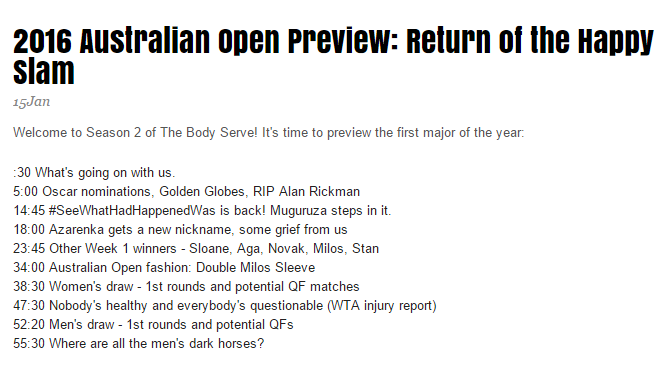
Don't miss the Season 2 opener from The Body Serve! As usual, Jonathan and James are serving up the laughs, the shade, and all the info you need to know about the 2016 Australian Open. 
Picture
0 Comments

2016 AUSTRALIAN OPEN PREVIEW: WHERE THE SEEDS FALL

1/14/2016

0 Comments

 
In a world where Roberta Vinci can defeat Serena Williams in the semifinals of the U.S. Open to halt a Calendar Slam bid, I've learned my lesson about making predictions. Accordingly, this 2016 Australian Open preview will not try to name the winners, but rather assess the state of the top 8 seeds' chances on both the ATP and WTA tours. 
Embed from Getty Images

Embed from Getty Images


Men's Seeds

1. Novak Djokovic

The world #1 and defending champion had a season for the ages in 2015. He reached the final of every tournament he entered, save for his season opening effort in Doha, and came within one match of potentially winning the Calendar Slam. But for Stan Wawrinka, I'm hard pressed to think of another player who could possibly derail him given all that we've seen the past 12 months. Perhaps a massive server like Karlovic, who beat him in Doha last year, or Kevin Anderson, who stretched Djokovic to five sets at Wimbledon?

1st  Round: Hyeon Chung
In his quarter: Kei Nishikori
In his half: Roger Federer

2. Andy Murray

You will likely hear a fair bit about a "Murray Baby Watch" in Melbourne over the course of the fortnight. Murray has said he will withdraw should he get the call during the tournament that his wife has gone into labour. Grand Slams are difficult enough without having such an enormous life change swirling overhead. That said, perhaps the lack of expectation will spur Murray into a spell of the carefree and aggressive tennis that he will need to summon for a title run.  

1st  Round: Alexander Zverev
In his quarter: David Ferrer
​In his half: Stan Wawrinka/Rafael Nadal

3. Roger Federer

Federer is one of two players (Wawrinka) who could realistically pose a threat to Djokovic in Melbourne. However, his uneven performance in his Brisbane final loss to Raonic clouds his readiness for a deep run. Reports from Brisbane also suggested that Federer was dealing with an illness during the tournament. If so, making the final at all was a notable achievement. If close to 100%, Federer is a safe bet to make the 39th Slam semifinal of his career. 

1st  Round: Nikoloz Basilashvili
In his quarter: Tomas Berdych
​In his half: Novak Djokovic

Watch: A visibly displeased Federer drops his racquet during Brisbane final defeat to Milos Raonic.

​CLICK FOR FULL MEN'S DRAW PDF

Read More
0 Comments

This (opening) week in tennis

1/10/2025

0 Comments

 
Welcome to the first installment of "This Week in Tennis," a weekly series recapping the goings-on in the world of tennis. The first week of the 2016 season delivered it all: familiar champions, new faces, retirements, withdrawals, drama, marquee match-ups, and young guns on the come-up. If this week is any indication of what's to come in 2016, we're in for quite a ride.
​

ATP​​
Embed from Getty Images

 
Week 1 winners:
  • Brisbane - Milos Raonic d. Roger Federer 6-4 6-4 (Avenges 2015 loss to Federer in Brisbane final)
  • Doha - Novak Djokovic d. Rafael Nadal 6-1 6-2 (Has now made at least the finals of every tournament during last calendar year)
  • Chennai - Stan Wawrinka d. Borna Coric 6-3 7-5 (Third consecutive title in Chennai and fourth in five years)

Spotlight:
​

Tennis fans were treated to the 47th edition of Djokovic vs. Nadal right off the bat in Doha. Those hoping for a reversal of fortune for Rafael Nadal were made to suffer through yet another convincing win by Djokovic; he has now won 11 consecutive sets versus Nadal spanning their last five matches, and 9 of 10 matches overall since Nadal beat him to win the 2013 U.S. Open. The 6-1 6-2 scoreline in a mere 73 minutes -- with Djokovic winning two-thirds of the total points -- underscores just how good the world number one has been over the last 12 months. For Nadal, a final to start his 2016 campaign is something he can continue to build on as he looks to ensure a more successful season this year than last. Incredibly, Djokovic actually increases his lead at #1 as his Doha title comes after losing in the quarterfinals to Ivo Karlovic last year. Spanning the last calendar year, Djokovic has not lost before reaching the final of any tournament he's entered. 

Other Standouts:
  • Bernard Tomic - SF, Brisbane (d. Mahut, Stepanek, Nishikori)
  • Dominic Thiem - SF, Brisbane (d. Duckworth, Kudla, Cilic)
  • Borna Coric - F, Chennai (d. Granollers, Krajicek, Bautista Agut, Bedene)
  • Aljaz Bedene - SF, Chennai (d. Pospisil, Vanni, Ramanathan)

Early Exits:
  • ​Defending Doha champion, David Ferrer, lost a 3-set opener to eventual semi-finalist, Illya Marchenko. 
  • World #17 Feliciano Lopez also lost in the round of 32 in Doha.
  • Seventh seeded Vasek Pospisil fell to Aljaz Bedene in his opening match in Chennai.

Read More
0 Comments

The Body Serve Tennis Podcast Season Finale

12/15/2015

0 Comments

 
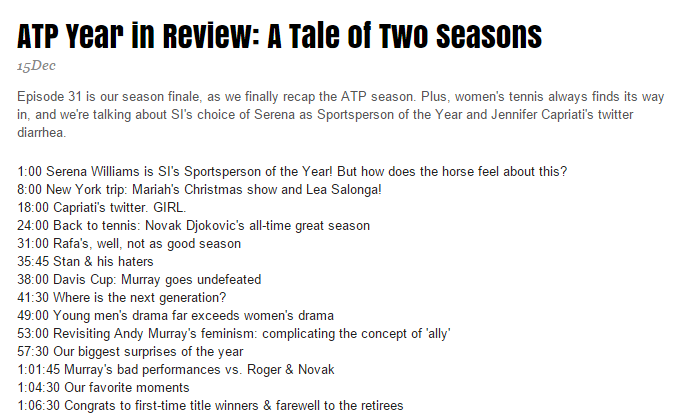
Jonathan & James return to put the finishing touches on Season 1 of The Body Serve Tennis Podcast. They present their 2015 ATP year in review and give their thoughts on Serena Williams winning the Sports Illustrated Sportsperson of the Year award.
Picture
0 Comments

WTA Year in Review: It's A Williams World

12/5/2026

0 Comments

 
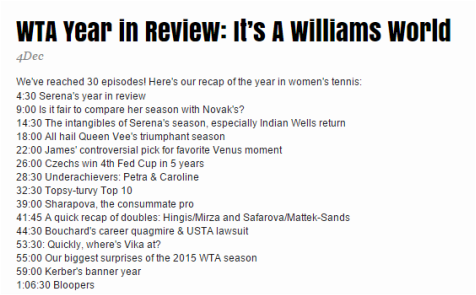
LISTEN: The Body Serve tennis podcast returns to recap all the happenings in women's tennis from 2015! In episode 30, Jonathan and James review the major stories that captivated tennis fans during the past 12 months.
Picture
Picture
0 Comments

Venus Williams Vaults Back Into WTA Top 10

11/9/2025

0 Comments

 
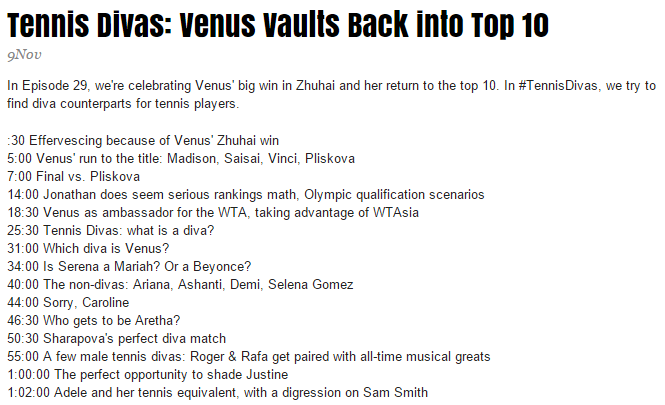
The Body Serve Tennis Podcast celebrates Venus Williams' return to the WTA top 10 after a near 5 year absence. The 35-year-old won the WTA Elite Trophy in Zhuhai to ensure she'll finish the 2015 season ranked #7 in the world. James and I also unveil our list of tennis divas, in which we discuss what it means to be a diva, and tell you who some of your favourite tennis players would be. 
Picture
0 Comments

Double Your Listening Pleasure: New Episodes from The Body Serve Tennis Podcast

11/4/2026

0 Comments

 
Picture
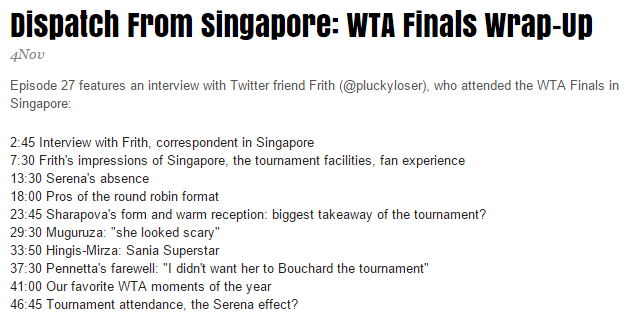
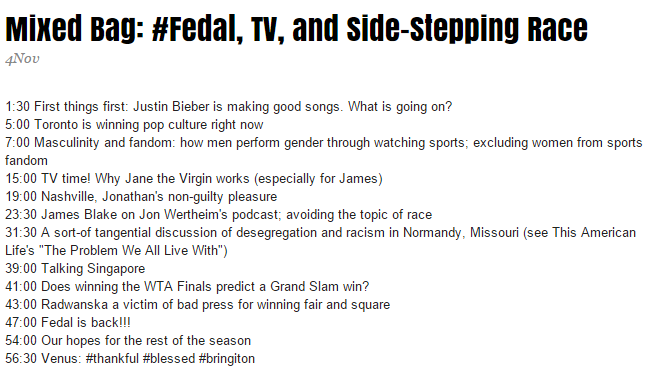
The Body Serve Tennis Podcast is back with two brand new episodes as both the WTA & ATP near the end of the tennis season. Both episodes are timestamped below for your listening pleasure. 

Got feedback? We'd love to hear from you on Twitter or shoot us a review on iTunes/share the podcast with your friends!

Picture
Picture
0 Comments

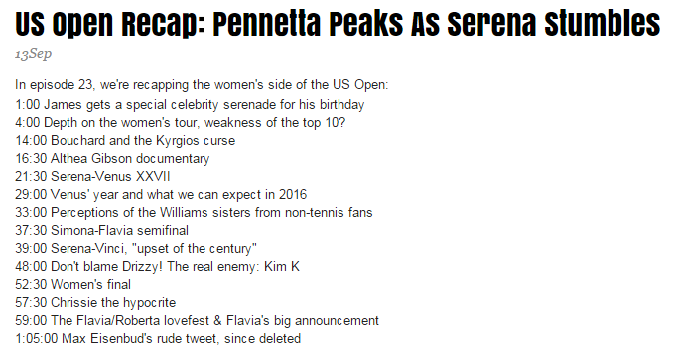
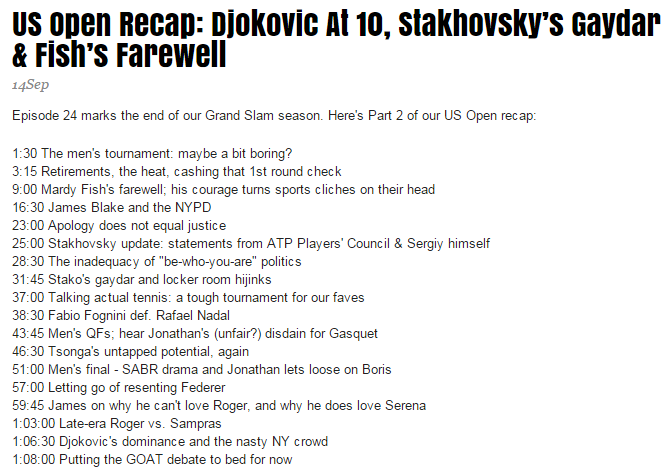
2015 U.S. Open Recaps From The Body Serve Tennis Podcast

9/14/2015

0 Comments

 
Picture
Photo credit: Jonathan Newman, Montreal/2015
The Body Serve tennis podcast is hosted by Jonathan Newman and James Rogers. 

Listen to both episodes below: 

Picture
Picture
0 Comments

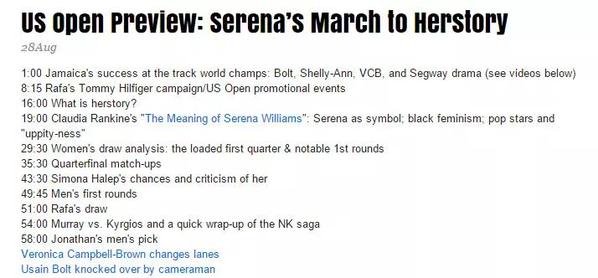
2015 U.S. Open Preview: Serena's March to Herstory

8/25/2015

5 Comments

 
Picture
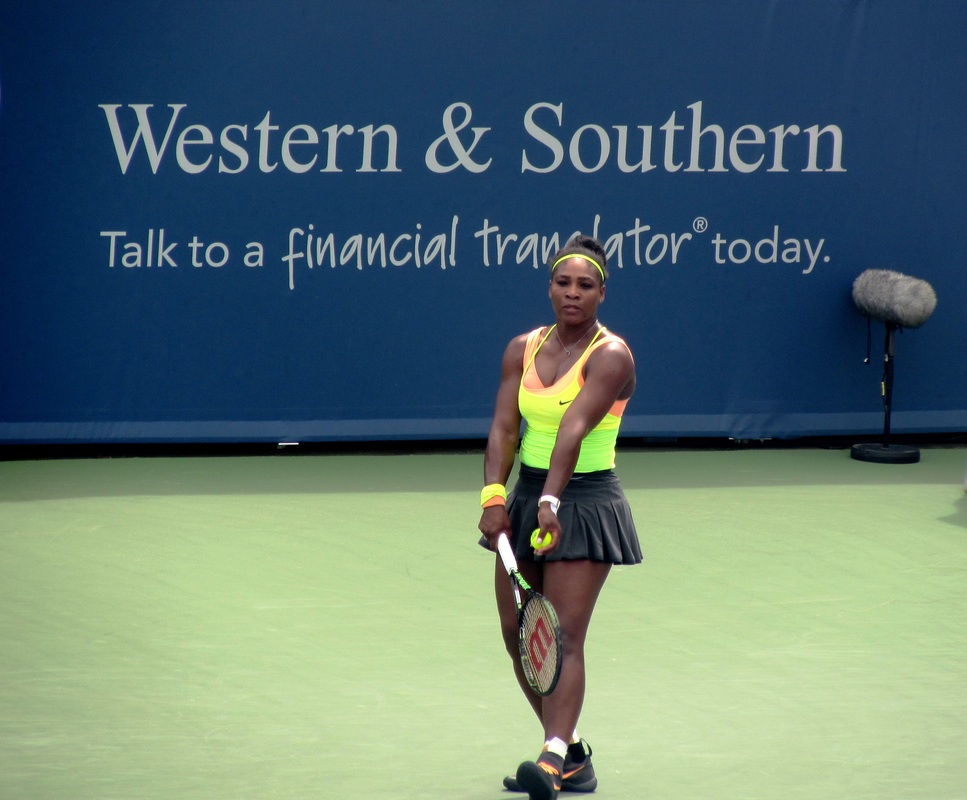
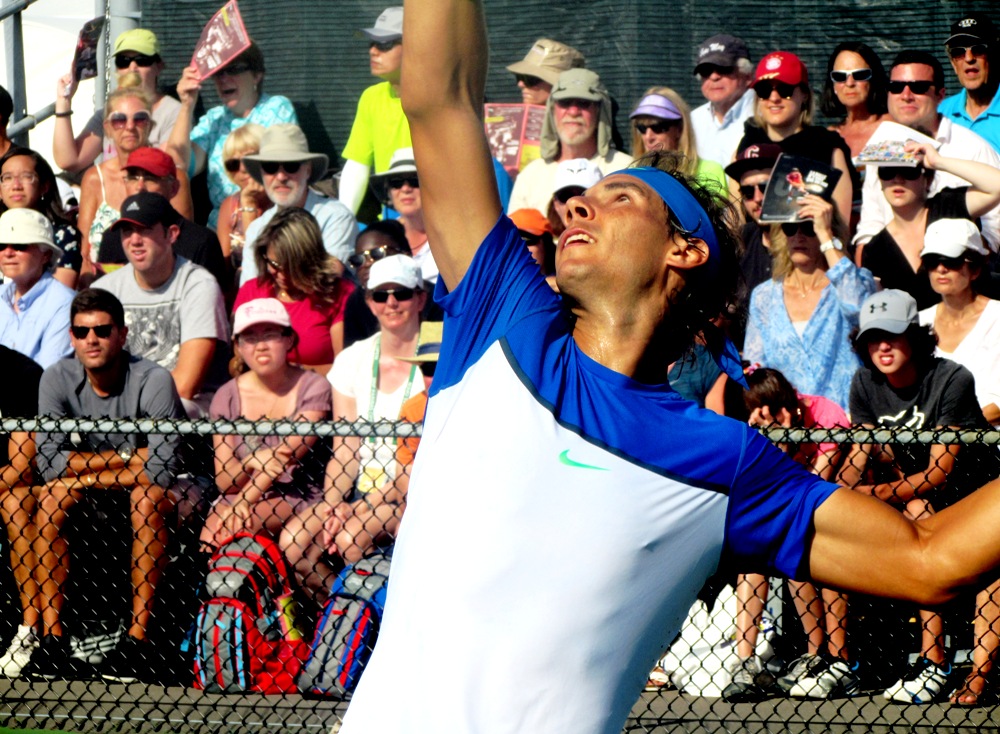
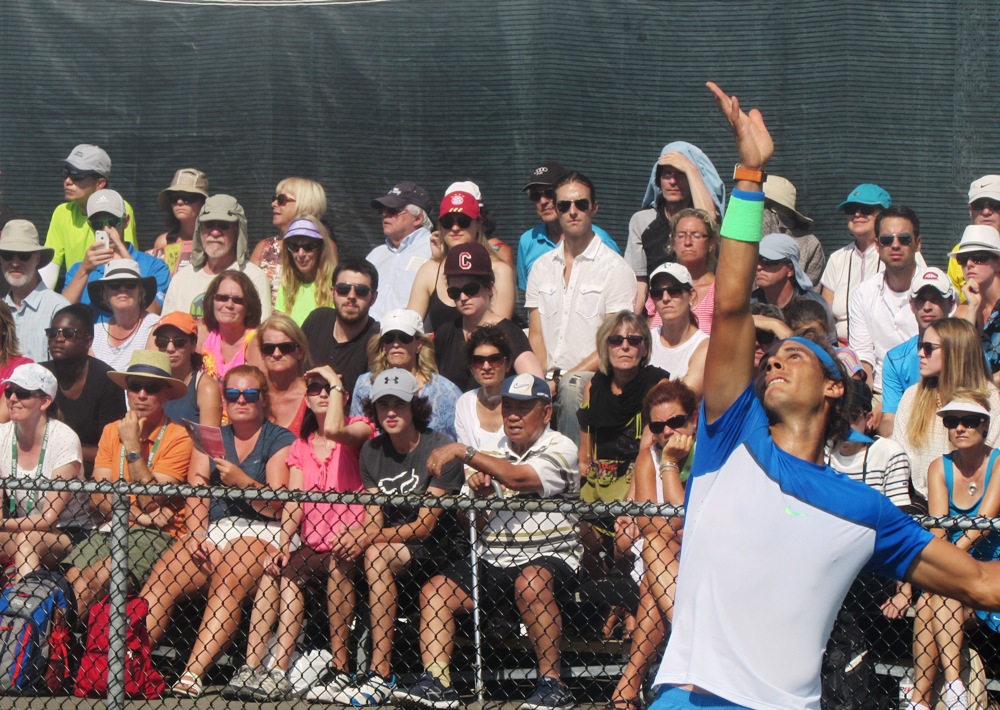
File photo: Jonathan Newman/Cincinnati 2015
THE BODY SERVE Tennis Podcast: Jonathan & James are back to preview the 2015 U.S. Open and Serena Williams' quest to complete the calendar Grand Slam. 
Picture
Picture
File photo: Jonathan Newman/Montreal 2015
5 Comments

The Body Serve Tennis Podcast Hits The Road

8/25/2015

0 Comments

 
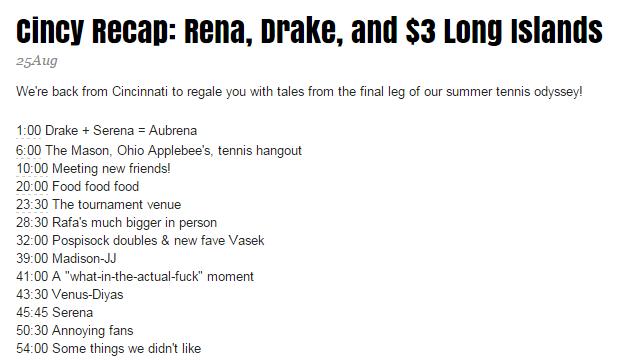
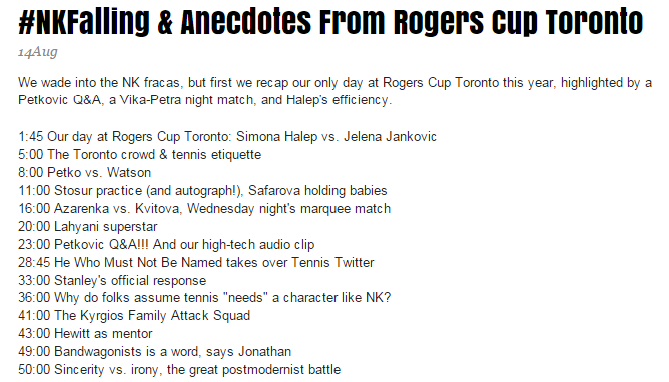
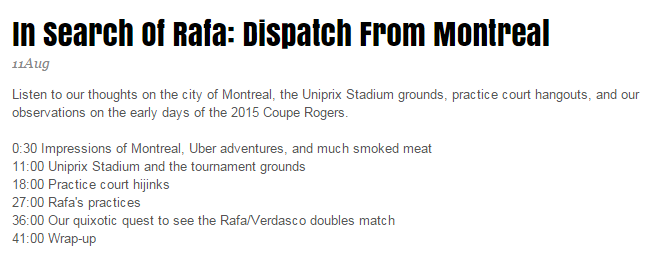
Jonathan & James hit the road to Montreal, Toronto and Cincinnati this August. Below are the three episodes of The Body Serve documenting their travels. Tune in to hear who they met, which players they saw & all the unique tennis experiences not captured on television. 
Picture
File photo: Jonathan Newman/Montreal 2015
Picture
Picture
Picture
0 Comments

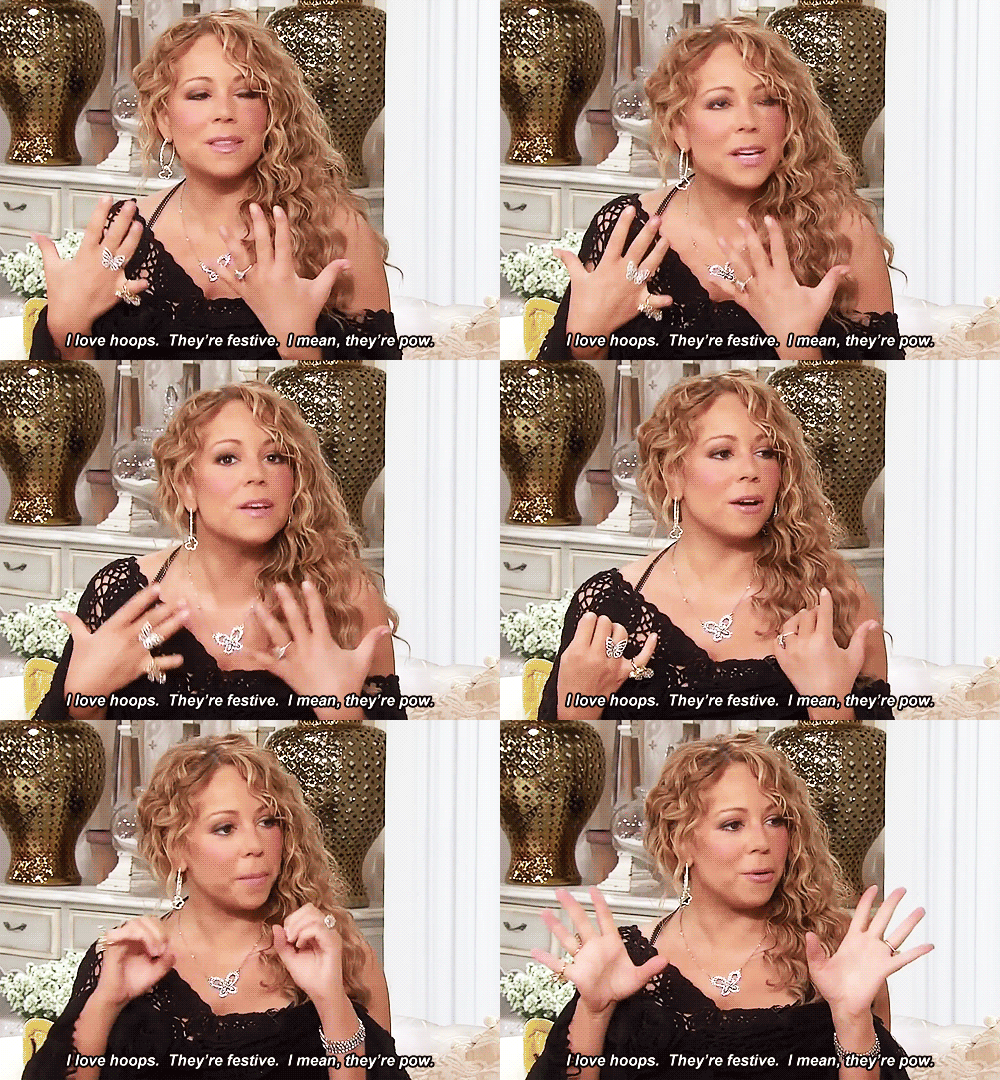
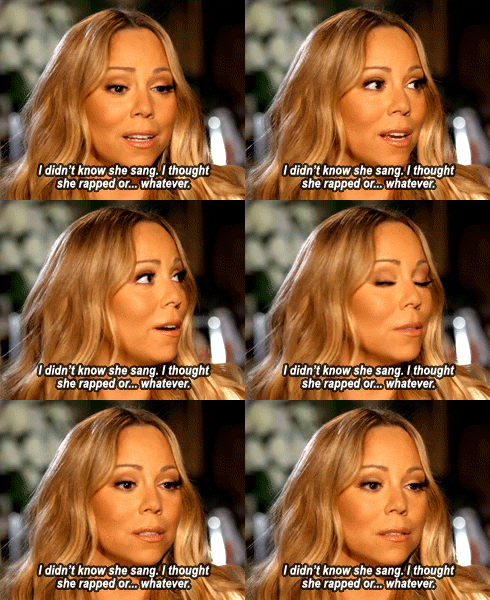
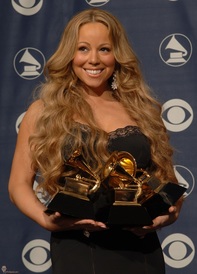
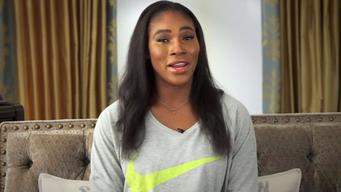
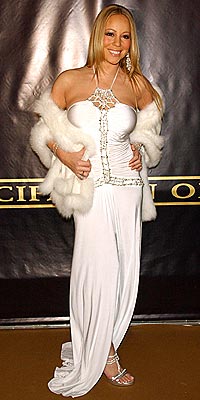
Why Mariah Carey & Serena Williams Are Basically the Same Person

7/24/2015

1 Comment

 
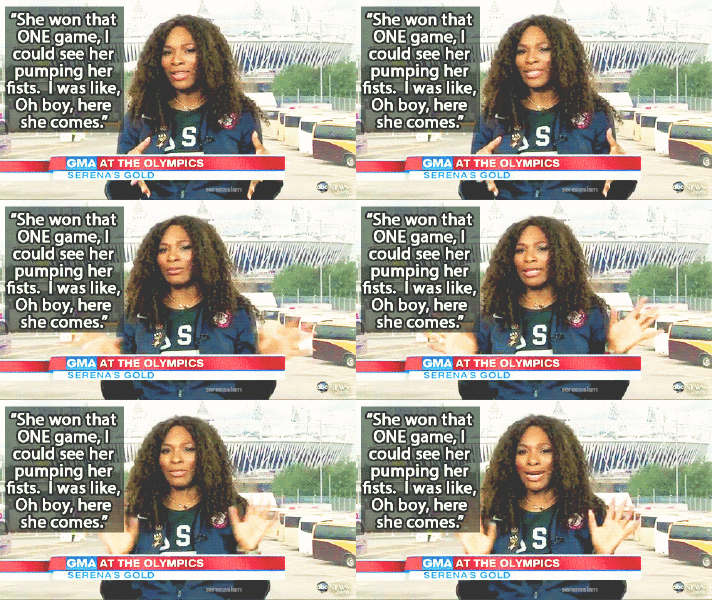
1. Queens of their domains: 18 #1s and 21 Grand Slams

Picture
Picture
2. They are two of the most GIFable people on the planet


Picture
Picture

3. Often imitated, never duplicated.
Picture
Picture

4. Both give hilariously Diva HSN appearances

Picture
Picture

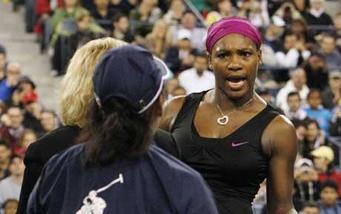
5. Well versed in the art of throwing shade

Picture
Picture

6. Known to have alter egos: Bianca & Taquanda
Picture
Picture

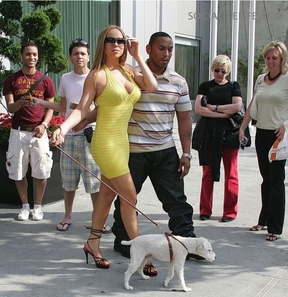
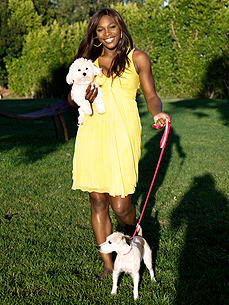
7. Both love small dogs.
Picture
Picture

8. Know how to stage a grand comeback.
Picture
Picture

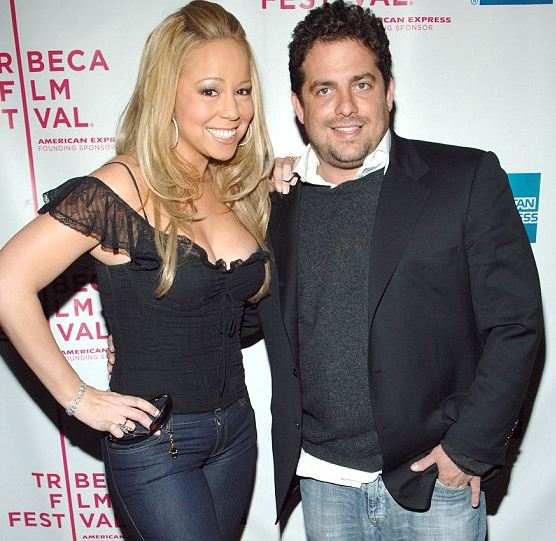
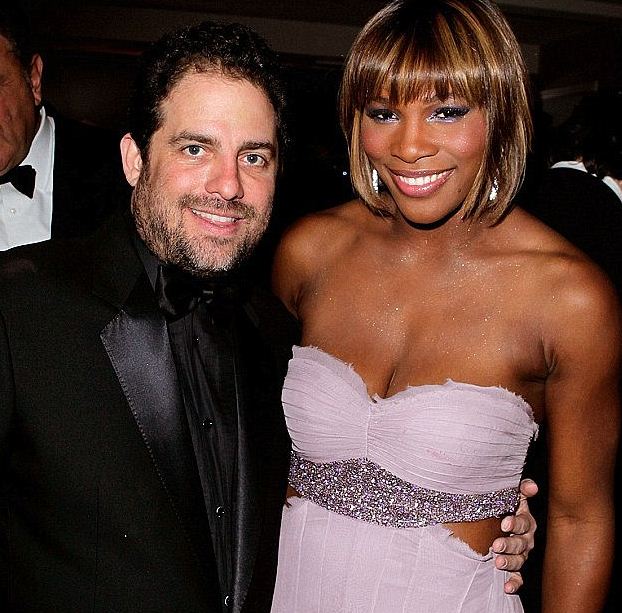
9. Brett Ratner is a mutual friend.
Picture
Picture

10. Mariah and Serena once wore the same Roberto Cavalli dress, in different colours and to separate events.
Picture
Picture

1 Comment

Why Andy Murray's Feminism Matters

6/25/2015

0 Comments

 
Picture
Photo taken by Jonathan Newman/Rogers Cup 2014
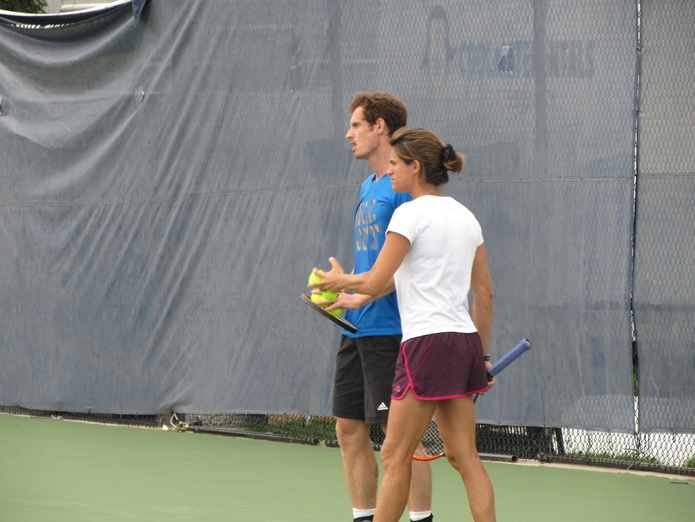
Andy Murray has announced himself to the world as a feminist. More than a year after hiring Amélie Mauresmo as coach, Murray still feels the need to defend her against what he terms “prejudice,” but what others may, more specifically, deem sexism. When he parted ways with Ivan Lendl last spring, the tennis world awaited the news of who would replace the “super coach.” Selecting Mauresmo was unconventional; few male tennis players – let alone one of the best in the world – had gone the route of hiring a woman coach before.

The responses to the Murresmo pairing have varied from rapturous support to ridicule. But, Murray has been steadfast in his support for the former world #1, doubling down in recent times: he spoke candidly at the Australian Open in support of Mauresmo, then followed up with an interview with Red Bulletin Magazine and a self-penned piece for L’Equipe in recent weeks. His insistence on giving their partnership every chance to succeed is intentional, as is his repeated public and unsolicited support of Mauresmo. Murray’s feminism may appear insignificant, but within a male-dominated sporting culture and society writ large, it matters greatly. It’s not just that he hired a female coach; he is trying, in his own stubborn way, to elevate the discourse surrounding women in sport.
 

Feminism Given a Bad Name
 

Feminism is a political doctrine and a social movement that refers to the belief in the “social, political, and economic equality of the sexes,” as Chimamanda Ngozi Adichie so succinctly put it.

Simply, feminists are people who see injustice done to women and aim to do something about it. This can apply to sexual violence, objectification, equal pay, abortion, slut-shaming, representation, and much more. But without an academic understanding of feminism, most people learn about it by taking cues here and there in their daily lives. While feminism has recently become more openly discussed on the internet and in popular culture (see: Beyonce, Nicki Minaj, tumblr), our culture still suffers from a lack of understanding of the goals of feminism.

Young people are generally not taught about feminism in schools, and so girls become women unable to situate themselves in relation to feminism as a continuing political movement. How many times have you heard someone say, “I am not a feminist,” even though you know that person to hold feminist ideals? This is the destructive legacy of misogyny and sexism; all that is left is the still metastasizing cultural conception of the bra-burning, anti-man, lesbian feminist. If you are not that, then how can you be a feminist?

This excerpt from Julie Zeilinger’s “A Little F’d Up: Why Feminism is Not a Dirty Word” goes a long way toward explaining how the definition of feminism gets muddied. The movement to cast feminism as “anti-man” is a very deliberate, and effective, tool in blunting its power, sabotaging the advancement of women’s issues, and molding it into preserving the patriarchy.

One of the most damaging myths of the movement is that men cannot be feminists. If girls get conflicting messages during adolescence as to what feminism is and whether they should identify as such, then the signals are far less murky for boys. Most young men arrive at adulthood certain that feminism is something reserved for women. Espousing feminist ideals is at complete odds with maintaining the necessary levels of masculinity to survive adolescence for most boys. The truth is feminism occurs on many levels. The woman who takes to the streets agitating for equal pay is a feminist in the same way the man who addresses casual misogyny at work is.
 

Sport and Feminism
 

As difficult as it is for feminist ideas to break through society’s consciousness, sport is a subsector even more impenetrable. Before children are even born, parents outfit them in all things pink and blue dependent on the baby’s sex. Children are streamlined into activities thought to be better suited to boys or girls. To be sure, women have made great strides in recent decades toward breaking this practice and showing that girls belong in organized sports. But, as a society, we are still failing our girls when it comes to how we value their athletic contributions, and the discourse surrounding female athletes.

Young boys and girls learn from very young ages where they stand in the sporting spectrum. We teach our kids that sports is the domain of boys, so much so that a 5-year-old boy knows how to taunt his little league friends by saying things like “you throw like a girl.” Then there is the shame cast upon the boy who has been outperformed by a girl, never mind that in their formative years, girls tend to develop physically at an earlier age. Even at such young ages, the sad truth is boys are aware that society values them more than girls. Moreover, boys are mindful that their own worth is a site of contestation when their athletic prowess is challenged by a girl. 

What makes life so difficult for women in sport is that their athletic achievement is always judged in relation to men. Society doesn’t know how to judge female athletic performance on its own merits without using men as a measuring stick. This is patriarchy at work; by using physical strength as the standard, society ensures that women will always be considered less than equal. Moreover, women are stifled by the perception that their bodies are delicate and must be protected from overexertion. Yet, they are considered inferior athletes if they can’t run as fast, throw as hard, or exhibit the same strength as men. It’s a lose-lose scenario.

Because these lines have been drawn, there is precious little space for feminist thinking in sports. Tack on the financial disparity in revenue between men and women’s sport and it gets even more difficult to cut through the densely formed narratives arguing against the worth of women’s sport. Serena Williams could never beat Roger Federer, so clearly women’s tennis is inferior to men’s tennis. Extrapolate this further and we see why some asked, “Mauresmo doesn’t know what it is like to play men’s tennis, so what could she possibly bring to Murray’s game to help him?” Women are meant to be docile, sexy, and the object of the male gaze; there is no room for them in elite sport, let alone coaching a man.

But for Murray, it was as simple as “she listened to how I was feeling.”
 

Why Andy Murray’s Feminism Matters
 

Socialization is often the most useful point of analysis to understand why people are the way they are. Jamaican sprinters are clearly naturally gifted. But, they aren’t biologically predisposed to running faster more so than people from other countries. There are underlying factors: poverty, lack of opportunity, cultural history, among others, that all play a part in producing a succession of gifted sprinters. Murray himself is a product of his environment. He values the input of women in his career because he grew up with his mother as a prominent guiding influence in his formative years.

In hiring Mauresmo, Murray put into action a decades-long set of values that he picked up through his socialization in sport. He is not restricted in the ways most men are in making the decision to hire a female coach; he learnt from a very early age, from seeing and doing, that even he can learn a great deal from Mauresmo. Great as he is already -- winner of 2 major tournaments, runner-up at another 6, and ranked as high as #2 in the world -- Andy Murray believes a woman can help him get better at his sport. 

Predictably, Murray’s decision elicited responses ranging from praise to ridicule. He was lauded by those who thought his decision bold, going against the grain of sporting culture, unconcerned with what anybody thought about him. There were those who dismissed Mauresmo as a token hire, unqualified for such a high-profile post, who couldn’t possibly have anything to bring to the table. There were the sexist comments, questioning how she’d be able to integrate into the team when she can’t even enter the locker room.

Murray even dealt with resistance within his own camp. Shortly after hiring Mauresmo, he and long-time member of his coaching team, Dani Vallverdu, parted ways. The circumstances surrounding their separation were murky until Murray clarified the situation in Red Bulletin Magazine. When talking about his lack of immediate success when Mauresmo came on board, he said:

“During that year I’d spent a total of two and a half weeks training with her. It clearly wasn’t her fault. Rather than doubt her, I started to wonder why no one was taking responsibility for their role in it. So I decided to move on.”

Rather than take the easy way out and lay blame at Mauresmo’s feet, Murray opted instead to cast aside those who were uncommitted to his course of action, showing that her hiring was not tokenism. Mauresmo is a former world #1 and two-time Grand Slam champion. She was a highly successful player in her own right, and one who also had coaching experience on her résumé ( briefly coaching Michaël Llodra, Marion Bartoli, and serving as French Fed Cup captain starting in 2013). Mauresmo’s hiring was groundbreaking, but what is even more important is how committed Murray has been to elevating the public discourse surrounding women in sport. Anybody could have made that hire, but very few would have been willing to be as unflinching in his support as Murray has.

Murray now has a pulpit and he is not afraid to use it for his new-found feminism. He credits his mother, and having her as a coach in his junior days, for giving him this perspective. In his interview, he acknowledges the damaging effects of machismo in sports. For Murray, being able to express his feelings is something of utmost importance to the success of his overall game. This is incongruent with how boys are socialized to suppress emotion, even more so in sport.

In Murray’s interview with Red Bulletin Magazine, he is asked plainly, “Do you regard yourself as a feminist?”

“[Long pause]. Good question. I don’t know. I’m pro everyone being equal and if that’s being a feminist then you could say so, yes. It really opened my eyes when I started working with Amelie. Inequality is something I started to see and become passionate about. It’s opened my mind.”

Murrays hits the same note in his op-ed in L’Equipe:

“Have I become a feminist? Well, if being a feminist is about fighting so that a woman is treated like a man then yes, I suppose I have.”

Murray’s circuitous answer to a straightforward question highlights what was previously discussed: most people are not able to pin down what exactly feminism is. His hesitancy to self-identify as “feminist” without some sort of qualifier also speaks to just how polarizing a word and movement it still is. It might help explain why, even though much of what Murray says and does is aligned with feminist thinking, he is still careful to embrace it fully. This is not to chastise Murray for not identifying the way I think he should. It is more an observation as to how misunderstood and divisive the word is.

Still, Murray’s willingness to speak is what sets him apart from everybody else on the ATP. While the likes of Gilles Simon and Janko Tipsarevic are concerned with women not deserving equal pay in tennis, Murray spends his time promoting up-and-coming female talent on Twitter, and singing the praises of his coach. It’s more than a matter of creating good optics, it’s being willing to stay the course and be a constant voice for progress when his colleagues either do the opposite or remain silent.

The ATP tour has done very little to address issues of sexism when they arise, turning a blind eye whenever its charges step out of line. Murray is the only player who has gone out of his way to disrupt the sexist discourse in tennis. This may seem like a small, insignificant thing; I assure you, it is not. In fact, that Murray is willing to take a stand, however small it may seem, is a massive victory for those interested in creating more access for girls and women in sport.

Murray’s feminism, no matter how underdeveloped it may seem, becomes elevated in the sporting landscape where there is too often very little space for women. He is a man at the top of his sport who uplifts women rather than partake in casual sexism and misogyny. It would be easier to maintain the status quo and just be one of the boys. Instead, he takes principled stands and agitates for better representation for women. His feminism, even if rudimentary, towers over what’s on offer from other prominent male athletes. We could use more men like Andy Murray.

 
For more on this issue, listen to our discussion on The Body Serve Tennis Podcast!
0 Comments

Serena Williams at Twenty: Her Career in Numbers

6/8/2025

0 Comments

 
Picture
Photo credit: Julian Finney/Getty Images
Serena Williams continues to dominate the WTA tour, even as she approaches her 34th birthday. Twenty years into a staggering professional tennis career, Williams’ resume keeps getting more impressive with each passing year.  In celebration of her 20th Grand Slam title, this list takes a closer look at Serena’s career with each number representing a milestone or significant occurrence in her pilgrimage to tennis history.

1: Williams has now spent 244 weeks as the top ranked player on the WTA (fourth all-time) and 121 consecutive weeks at #1 (active – third all-time).

2: Serena’s tennis prowess extends to mixed doubles where she won two titles partnering Max Mirnyi in 1998. In fact, she made four consecutive mixed doubles finals from ’98 French Open through ’99 Australian Open.

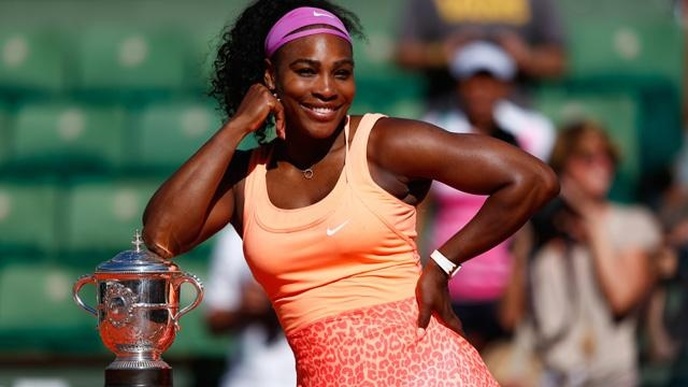
3: With Saturday’s win over Lucie Safarova in the Roland Garros final, Williams now owns three French crowns and can claim to have won a career grand slam as many times. The number also represents the few times she’s made it to the semifinals of a Slam without advancing to the final (24/27).

4: Both Williams sisters own four Olympic gold medals: one each in singles, and three in doubles.

5: To date, Serena has won five Venus Rosewater Dishes at Wimbledon and a matching number of Tour Championship titles.

6: Williams has six wins each at the U.S. and Australian Opens, the most by any player at either event (she shares first with Chris Evert at U.S. Open).

7: Serena has lost only seven WTA finals in the last decade (42-7). Seven also denotes the number of times Williams has won a match 6-0 6-0 in her career.

8: Number of times she’s played her sister in a Grand Slam final (6-2).

9: Years since Chris Evert wrote her (in)famous open letter to Serena urging her to focus more on tennis. Almost 24 at the time, Serena has since added 13 Slams to surpass Evert as the top American titlist.

10: Total number of finals made by Williams at the Miami Masters, winning eight.

11: The number of years in between winning French Open titles (2002-2013). It was also at age 11 that Serena was asked, “if you were a tennis player, who would you want to be like?” Her response: “I like other people to be like me.”

12: Total number of clay court titles won by Williams in her career, the most of any active player. Her 12 hard court Slam titles are also the most in tennis history.

13: Venus and Serena have partnered to win 13 Grand Slam doubles titles, never losing in a final. The number also represents the grand sum of losses by the sisters in Slam doubles events (115-13).

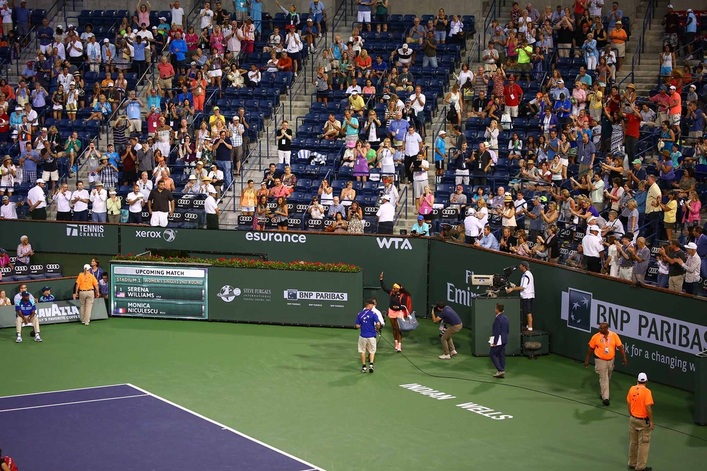
14: Having once vowed to never return to Indian Wells, Serena changed her mind and played the event in 2015 for the first time in 14 years.

15: The number of years between her first and most recent U.S. Open titles (1999-2014), an all-time record.

16: Consecutive wins over Maria Sharapova, dating back to 2004. After losing back-to-back matches that year, including the Wimbledon final, Williams has not lost to Sharapova in almost 11 years. Sixteen is also the total of #1 players Williams has beaten in her career.

17: How old Williams was when she won her first Slam title at the 1999 U.S. Open, and the number of WTA finals lost by Williams over her career (67-17).

18:  Record-tying number for Williams, who joined Chris Evert and Martina Navratilova as winner of 18 Slam titles with her 2014 U.S. Open triumph.

19: (93-19): Number of total career losses when combining Williams’ record against 10 multiple Slam winners: Sharapova, Li, Kuznetsova, Azarenka, Clijsters, Kvitova, Mauresmo, Pierce, Davenport, and Seles. Her record against the trio of Hingis, Capriati and Henin is a lesser, but still impressive, 39-30.

20:  Williams owns a 20-4 record in Grand Slam finals. Moreover, she’s won 20 of a total 59 Slam singles events entered – a clip of better than one out of three. This season also marks the 20th anniversary of Serena’s first professional tennis match.

 
For more post-French Open analysis, check out our podcast at The Body Serve. 
0 Comments

TENNIS PODCAST: 2015 French Open Preview

5/23/2015

2 Comments

 
Are you prepared for the 2015 French Open? 

The Body Serve tennis podcast has you covered with complete draw analyses and players to look out for at the tennis season's second Grand Slam.


The Body Serve is a new tennis podcast - casual, semi-respectable conversations about the ATP & WTA 
Hosted by Jonathan Newman & James Rogers
Available on iTunes
2 Comments

The Body Serve Tennis Podcast: See What Had Happened Was....

5/7/2025

0 Comments

 
In #SeeWhatHadHappenedWas, we:

- Introduce a new segment, in which you'll hear our expertise on a salacious happening in the tennis world, past and  present (starting with Andy Murray's dressing-down of Lukas Rosol)
- Indulge our nostalgia by recounting what sparked our interest in tennis.
- Talk about our favorite players from yesteryear.
- Discuss why tennis inspires such a devoted following.


The Body Serve is a new tennis podcast - casual, semi-respectable conversations about the ATP & WTA 
Hosted by Jonathan Newman & James Rogers
Available on iTunes
0 Comments

The Body Serve Tennis Podcast: Boys Will Be Boys, If We Let Them

4/7/2025

0 Comments

 
It's episode 9, and we're looking at:

- The perceived weakness of the WTA vs. one player's historic dominance.
- Sexist double standards as they apply to dominance and parity.
- Simona Halep's continued ascent and the question of rivalry with Serena.
- Djokovic's bad behavior and the "boys will be boys" ethos.
- Our new game: #NameTheTennisPlayer


The Body Serve is a new tennis podcast - casual, semi-respectable conversations about the ATP & WTA 
Hosted by Jonathan Newman & James Rogers
Available on iTunes
0 Comments

The Body Serve Tennis Podcast: The Tennis Commie Manifesto

3/17/2015

0 Comments

 
We're back for episode 7:

- What makes an effective tennis commentator?
- The assorted errors, gaffes, and malapropisms of the ESPN set (or: The McEnroe Effect).
- Tennis' complex web of conflicts of interest.
- Our takedown of Justin Gimelstob, the Teflon Commentator.
- How has Gimelstob managed to keep his job(s)?
- Failure of leadership, and the organizational chaos that keeps tennis directionless.
0 Comments

Serena Williams: Ready to Make Nice, Not Ready to Back Down

3/16/2015

0 Comments

 
Picture
Forgive, sounds good
Forget, I’m not sure I could

Richard Williams and Oracene Price may have envisioned their daughters as Grand Slam champions, but tennis has never been just tennis for Serena and Venus Williams. They emerged as black tennis prodigies in a sport ill-equipped to deal with their rise to stardom. From the beginning, their impact on society would always outweigh anything they accomplished on the tennis court. 

Their blackness has shadowed them at every turn throughout their illustrious careers. When Richard Williams spurned the tennis establishment and rolled them out to the tennis world on his terms, the colour of their skin became a focal point, accentuated by the beads that they wore so boldly in their hair. The insidious nature of racism muddied the waters of their youth; instead of carefree, talented teens, they were often seen as brash and disrespectful upstarts. Richard and Oracene may have tried to prepare them for what would follow, but as mere teenagers, Venus and Serena had the unenviable task of adjusting to the shadow of their blackness while attempting to scale the tennis mountain.

By now, we are all familiar with what happened at Indian Wells in 2001; the incident left the Williams sisters vowing never to return to the tournament. In the 14 years since, interested parties had been left to speculate whether either sister would ever return, and what their thought processes were about the debacle. One of the most rewarding aspects of Serena's return this year has been the access she has granted us into how she and her family felt about and dealt with what transpired.

There is no longer any need to speculate. Read Serena's words. In her letter for TIME, Serena lays bare her thoughts and feelings about Indian Wells (she also wrote about it in a chapter in On The Line). We learned that the events took a toll on the entire family, not just Venus and Serena. The boos and insinuations cut deep, caused Serena great self-doubt, and "haunted" her for a long time. In the letter, she also indicated her awareness of her own place in history and the role race has always played in her tennis. The mental and emotional fallout for Serena was greater than we ever imagined. 

Serena's decision to return to Indian Wells should put to rest any conjecture as to what happened. We now have her own words, in great detail, about what she experienced against Kim Clijsters that day. We must now defer to her if we are serious about understanding what it feels like to have a home crowd root so whole-heartedly for your opponent, to watch your family booed from the stands amidst racial slurs, all the while trying to win a big-time tennis tournament. We should use her words as a template of what it is like to be black, a woman, and a tennis champion.   
I’m through with doubt
There’s nothing left for me to figure out

For all their practice, preparation and confidence, even the best competitors in every sport have a voice of doubt inside them that says they are not good enough. I am lucky that whatever fear I have inside me, my desire to win is always stronger.
Serena is not just a tennis player, and has now shown us she is ready to champion her blackness and embrace the political. Serena wants to ensure we never forget what happened to her family in 2001. As part of her return to Indian Wells, she teamed with the Equal Justice Initiative to raise funds for persons who have been denied fair treatment by the U.S. justice system. 

Of all the thousands of charities Serena could have chosen, she chose this one. Her partnership with EJI shows that Serena is not willing to sanitize what happened in 2001; she is aligning her experience with those represented by EJI. Serena will play Indian Wells, but she does not want us to forget why she stayed away for 14 years. She was the victim of an ugly incident coloured by race, and while tournament organizers and the media would prefer to herald her return as a triumphant, feel-good moment, it is more than that for Serena. She is unwilling to tie a neatly wrapped bow on it and leave it at that. The emotional scarring she and her family endured will not allow it.  

Serena made her return to Indian Wells last Friday night.
Her tears and those of her sister Isha underscored the emotional release of the moment just as much as it granted a glimpse into the hurt the family endured over the last 14 years. Venus' continued absence from the tournament is a reminder that the Williams family, trailblazers for African Americans in sport and American society, maintain a complicated relationship with all of us. Venus' decision not to play this year, or ever again, is just as valid as her sister's. 

Serena's return to Indian Wells gives her the control to steer her narrative going forward. But, make no mistake, she is not re-writing her history or what happened in the '01 final. By "making nice," Serena is at once conquering her scarred personal history and giving herself a chance to move forward. We should never forget what happened to the Williams family in 2001, and I suspect that is precisely what Serena is hoping for.  

They say time heals everything
But I'm still waiting.

LISTEN: James Rogers and I talk about Serena & Indian Wells on The Body Serve Tennis Podcast.
0 Comments

The Body Serve: Talking Race & Serena's Return To Indian Wells

2/17/2015

0 Comments

 
In Episode 5 of The Body Serve, we discuss Serena Williams' decision to return to Indian Wells:

- The 2001 IW final and the Williams' ensuing boycott
- How race and racism have shaped the Williams' careers
- Serena's legacy and her evolving politics
- Does the U.S. celebrate its black athletes like it does white athletes? Are there strings attached? 
- How do blackness, patriotism, and racial politics intersect?


The Body Serve is a new tennis podcast - casual, semi-respectable conversations about the ATP & WTA 
Hosted by Jonathan Newman & James Rogers
Available on iTunes
0 Comments

Australian Open Day 9: Press Conference Snippets

1/27/2015

0 Comments

 
Rafael Nadal's straight-set loss to Tomas Berdych dominated headlines on Day 9. Nadal waxed philosophical in his presser, refusing to engage in hypotheticals while crediting his opponent's strong and steady play. Bucking the cliche, though, he didn't take the bait when asked if Berdych can go all the way, noting the excellent form of other top players. Nadal's vanquisher allowed himself one day to enjoy the victory while coach Dani Vallverdu scouts his next match. Simona Halep put in a bleak performance against a surging Makarova, and seemed eager to move onto the next tournament. 

Andy Murray, the youngster killer of this Aussie Open, silenced Nick Kyrgios and the Aussie crowd. In press, he chats about Kyrgios' on-court behavior, and downplays the drama of playing against former coach Dani Vallverdu. (Longtime friend and assistant coach Vallverdu left Murray's team on not-so-great terms, allegedly due to tension regarding Andy's hiring of Amelie Mauresmo.)

Maria Sharapova destroyed the hopes of another young gun, routing Eugenie Bouchard. She shared some quips from her father and ex-coach, Yuri, who clearly knows that the straightforward approach works for his daughter.


Q. We will never know, but do you think if you had won that third set it could have changed everything, or were you still feeling that Tomas had a little bit the upper hand?


RAFAEL NADAL: "If" doesn't exist in sport. That's the real thing. If, if, if - never comes. The thing is, you have to do it. I didn't have the chance to play the fourth; I lost the third, so that's it. That's sport. I lost the third. He's happier than me in the locker room. I am not very happy because I didn't competed the way I wanted to competed the first two sets and that's something that I don't like. But I tried my best again in the third. I was closer. I had some chances with the 4-All, some breakpoints. The tiebreak I was there fighting even that the situation was tough. But he played aggressive. The tiebreak, he served well. Two sets to love advantage makes the opponent play with more calm than if he is one set to love or one set all. That's a big difference.

Q. Speak a little bit about Berdych today. Do you think he has what it takes to go all the way in this tournament?

RAFAEL NADAL: I don't know if he can go all the way to win this. There's so many good players there that are playing very well. Andy is playing so well. We'll see. It's true that Tomas is playing well. Just happy to see the way that the tournament develops. The best players are there fighting for the tournament. Tomas is a very regular player that he deserves to be there. He have been in the top positions of the rankings for a long, long time, being very regular, being very professional on what he's doing. So he deserve that. And now let's see what's going on, no? For me, I feel that he resisted well in the third. But before was too easy for me to analyze the way he played. He played well, obvious. But my feeling was that I help him a lot in the beginning, no? Is easier to play well when you are up in the score, one break up, two breaks up from beginning of every set, no? That's a big deal, big difference.


Q. When you were out there really taking it to Rafa, what were you saying to yourself? Must have felt great.

TOMAS BERDYCH: Oh, it feels great. I mean, really the good thing is, as I said, the plan that we put together was the right one. Everything was working. I was able to execute it really well. But still, I mean, until the last point you can't think about anything else. You have to really keep going till the last one. When it's done, it's done. It's great. But I might be thinking about it and enjoying the time probably till tomorrow morning. When I woke up, I need to get myself ready for another one. As I said, I mean, there is a still long way to go in this tournament and I need to be ready for it.

Q. Are you watching the match tonight or do you prefer to enjoy your win doing something else?

TOMAS BERDYCH: No, actually, I'm going to keep Dani watching that match. I think that's the job for him. I don't have to spend really all the time to looking at that. But, yeah, I mean, I'm going to see something definitely. I mean, I'm interesting in that. I want to see something from it. But, as I said, you know, today I have the only time I can enjoy the victory. Since I wake up tomorrow morning just all the focus goes for the next opponent and my next match.


Q. Probably not your best today. Did it feel bad before the match?

SIMONA HALEP: I practiced very well in the morning, but maybe I was a little bit too stressed before I started the match. Wasn't my good day. I had a bad day. But she played well and everything was in for her. So she deserves this winning. I'm really sad a little bit now that I could not play my tennis, my game, but that's tennis and I have to look forward to the next tournament.

Q. Do you think you put pressure on yourself being the favorite in this match?

SIMONA HALEP: Not really pressure. I cannot say pressure. Just I was a little bit stressed. I don't know why. I had experience from last year to play quarterfinals, so it doesn't mean that I felt pressure. Just I didn't feel the game, the ball. Was a very bad day for me.


Q. We were all 19 once. What do you make of his on-court demeanor, showboating, that kind of stuff?

ANDY MURRAY: I actually think he's quite respectful on the court in many ways. He does applaud good shots. He does say, Good shot, good serve. Yeah, he gets frustrated with himself and sometimes says things he shouldn't, but everyone, I would think, has done that in some way when they're 19. It just happens that when he's doing it he's playing in front of a large audience and it gets picked up on. I've spent a little bit of time with him and I think he's a good person. I don't think he's a bad guy. He's nice. He's always been polite and respectful. Yeah, maybe he does the odd thing on the court that might annoy some people, but I don't think he does anything with bad intent. He's only going to continue to mature and improve in that respect as he gets older. He just needs to be allowed to grow up. Like everyone makes mistakes when they're that age.

Q. What will it be like having Dani in the opposite box in the semifinal for the first time?

ANDY MURRAY: I don't know. When I finished working with Miles MacLagan he started working with Baghdatis. I played against Baghdatis a few times. I played him at the Olympics. I played him in Tokyo with Miles there. Yeah, with Miles there I didn't really have an issue with it. But, again, I don't know, maybe I'll find it weird on the day. But, yeah, it's just something that you deal with as a player. My goal isn't to beat Dani; my goal is to beat Berdych. So I don't think about that in the next days.


Q. What did he say to you?

MARIA SHARAPOVA: In a nice version, it was like, This is unacceptable (smiling). He's like, It is much easier just having a normal home life. You should try it. I don't know why you're suffering out there for nothing. Make it easier for yourself.

Q. He feels like you're suffering for nothing?

MARIA SHARAPOVA: Well, he told me that I was working much harder than I had to. If I was maybe a little bit smarter, did a few things maybe a little bit differently, maybe it could have been easier.
0 Comments

Australian Open Day 8: Press Conference Snippets

1/26/2015

0 Comments

 
Day 8 was a big one for American women, with two Williams sisters and a Madison advancing to the quarterfinals. While Venus' fans are ecstatic, she seems to be keeping a level head, noting that she's "been here before." Serena had to rely on a little on-court coaching, albeit from a boisterous fan who told her to use more spin. (She followed the advice, and it worked.) She also remarked that she loves the crowd's appreciation for her in Australia, something she doesn't get everywhere she goes. Novak Djokovic seemed a bit confused about a serve-and-volley question; a reporter said that his opponent used the tactic successfully against Djokovic, although Muller's straight-set loss seemed to indicate otherwise. Breakout star Madison Keys reminds us that she's still a teenager with talk of emojis. And finally, just when you think all possible questions about The Sleeve have been asked and answered, a reporter asks the same ones, again.


Q. Because of the opponent, because of the occasion, does it feel like the biggest win for you in a while?

VENUS WILLIAMS: I don't know. I mean, I guess from the outside looking in, I guess it could look like that. But for me I'm just really focused and poised right now. I feel like I've been here before, so it's not like I'm jumping up and down for joy, Oh, shoot, what is this? I've never done this. Yes, I've done this. This is what I'm always going into each tournament thinking I want to do, even when I fall short. It's definitely not the first time. I guess that's how I feel.

Q. Do you feel your performances affect people and are an inspiration?

VENUS WILLIAMS: Definitely. I think all of us touch lives in ways that we never dreamed of growing up as kids. You just want to be No. 1 in the world, you want to win a major. You never think about the people you inspire from your efforts and your attitude. Yes, that's been my experience in my life and most professional players I think it's their experience as well.


Q. When that person in the stands called out, Use some spin, did you follow up on that?

SERENA WILLIAMS: I did. I was like, you're right. I'm trying to do that anyway, but I wasn't doing it. So my fan coach was like, Use some spin, Serena. I was like, Okay, okay. It's been like really great. I hear my name throughout the whole stadium like 360. I don't get that everywhere. It feels good.

Q. Why do you think there's such an in and out in terms of getting that?

SERENA WILLIAMS: I think when you win often, sometimes people want other people to win. They forget that you want to keep winning, too. And that's okay. You know, I'm used to it.

Q. It is nice that you're taken for your results?

SERENA WILLIAMS: I get that every year in Australia. That's one of the reasons this is my favorite place to come. I really love it so much.


Q. What is serve and volley's future in your opinion? Because he did it tonight successfully.

NOVAK DJOKOVIC: Him?

Q. Yes.

NOVAK DJOKOVIC: I go to the net to shake hands (smiling).

Q. What is the future of the tactic?

NOVAK DJOKOVIC: That's a good question. It really depends how the technology is going to advance, what are we going to do with the balls as well. Are they going to become faster or slower? My subjective feeling for the Australian Open, I talked to many players, the last two years the courts or the balls, something out of these two elements have speeded up the game here in Australia. It plays faster. It allows the servers to have more free points, come to the net. On a cold night like tonight, the ball didn't bounce very much. He tried to chip and come in. He played smart. Made me uncomfortable in some moments on the court. That's what serve-and-volley players do. You don't get to see that many serve-and-volley players these days. The future, it's hard to say if it's going to go back to what it was 20, 30 years ago. I highly doubt that. Depending on technology and certain changes, if the game becomes a bit faster, the players will adjust to it.


Q. How big a milestone does a first slam quarterfinal feel to you?

MADISON KEYS: It feels really good. My mom texted me before the tournament. She said, It's your last Grand Slam as a teenager, and sent me a bunch of grandma faces. I'm like, Thanks for reminding me, Mom. Thank you. Love you. It's huge. But it's my last slam as a teenager. I'm doing so well and hopefully I can keep it up.

Q. What would be the emoji that describes your general sense right now?

MADISON KEYS: You know, the one that she's in a salsa dress dancing. That would be me right now.


Q. How long have you been wearing a sleeve?

MILOS RAONIC: Since Miami of last year.

Q. Is that precautionary?

MILOS RAONIC: First it was for medical purposes. I had a rash and I couldn't have my arm in the sun, so I had to play with long sleeves. I wasn't really too fond of that, with the warmth in Miami. I went on with that. I've liked the feeling ever since. It's compression. Never feels like it gets too hot. But on a day like today that's cool, it feels like it's nice and warm.


0 Comments

Australian Open Day 7: Press Conference Snippets

1/25/2015

0 Comments

 
The final rounds of the 2015 Australian Open are taking shape with several of the sport's biggest names still alive in the tournament. See what some of the the major players had to say about their play yesterday.


Q. You think they would take requests? (Genie's Army)


EUGENIE BOUCHARD: I was thinking about it, because I really want them to start singing some Taylor Swift. Hopefully they will see this and maybe work on it. That would be really cool. Maybe I'll ask them to do that. I'll be really motivated if they do that. Like if I'm down, start singing Taylor Swift and I'll be motivated.


Q. What do you remember most about the match with Sharapova in Paris?

EUGENIE BOUCHARD: I kind of just remember a grind. I didn't feel like I was playing great tennis the whole time. Sometimes here and there. But that's what it's about: trying to win and trying to always play better, get through it, even if you're not playing your best. I felt like I was close with her. She probably wasn't -- we were both maybe a bit off. You're never really playing amazing. Maybe 10% of the year. So I remember that, and I remember I had chances and stuff. I just remember a tough match. I was pretty disappointed after, so that's motivating.


Q. She's compared to you quite often for various reasons. Can you see the similarities and can you remember what it was like when you were coming through the same way?

MARIA SHARAPOVA: Yeah, I think we all want to go through our own paths and we all want to -- when I was coming up, I was compared to Kournikova for many years in my career and still occasionally name always comes up in interviews and articles. That's just part of it, part of the game, part of the business. It's understandable. It is what it is. As I have said, I believe I was still a teenager, I don't want to be the next anyone. I want to be the first Maria Sharapova. And that's how I've been throughout my whole career. And we all want to create our own path and go through our own career. And we're all destined for some sort of thing. We work extremely hard at a sport, and that's what we want to be known for.

Q. Do you see any of yourself in Genie?

MARIA SHARAPOVA: I personally don't know Genie very well. As a tennis player she's a big competitor. She's an aggressive player as well that likes to take the ball early and dictate points. From that perspective, yeah, definitely.


Q. Until the game that you broke him in the first set, you had only won one point on his serve. Was it a matter of you figuring out the serve, or did his level of serving drop?

RAFAEL NADAL: I don't know if you saw that, but I changed completely the position on the return. I was returning very close to the baseline. Is easier to start more aggressive and make the transition aggressive to defensive than defensive to aggressive. So is something that I talk before the match, and we decided to go close to the baseline in the beginning. Then if was not working, try to play more points. I had that feeling that I need to make him feel that he needs to play a winner to win the point, no? Because before my feeling was he was winning too many points only with the serve. So I tried to change that at the end of the first set. I was able to have some good returns. One very good one, but then the other ones, just put the ball inside the court and then try to let him think a little bit more than what he was doing until that moment. That's what changed the dynamic of the games on the return. Very favorable way for me.


Q. What is the meaning of what you're writing on the lens of the camera?

RAFAEL NADAL: Doesn't matter. Is stupid thing. With my friends, that's it.


Q. What kind of help has it been with a new coach, a fresh pair of eyes from Dani taking on Rafa this time?

TOMAS BERDYCH: Let's see. It's going to be easier to judge after the match. So far, as I said in the past, we didn't spend that much time together. But the good thing is that I'm able to, you know, execute the things that he's telling me what to do, how to set up for the matches. So far it works pretty well. I think it's definitely the advantage which I was surely looking for.

Q. You had that famous volley with the two sets lead against him a couple years ago here. You don't remember that?

TOMAS BERDYCH: To Rafa?

Q. Yes. You had a volley for two sets to love.

TOMAS BERDYCH: Okay.

Q. You came very close then maybe to beating him. Does that give you confidence that you can play him that tough on a big stage here?

TOMAS BERDYCH: No, it has nothing to do with that. Definitely not. As I said, every slam is different. Every opponent, even if is the same one, then the match is different. So, no. It's going to start from 0-0. That's how it is. No comparing with the past. Just trying to be in this time and looking forward to it.


Q. Did you feel like you were a bit jinxed at the end?

GRIGOR DIMITROV: Jinxed or not, when you play a match like that, you don't actually think about anything. I'm not going to hide my disappointment. I'm pissed.


Q. In terms of sustained quality, might that be as good as you've played since the back surgery?

ANDY MURRAY: It's very difficult for me to say right now. But in terms of how my body felt, if it was the best I played, my body allowed me to play that way for the whole duration of the match. I didn't feel tired. I felt fresh. My back felt good. I wasn't feeling stiff at all. I don't normally say stuff like this, but for me the compression garments that I'm wearing just now are genuinely exceptional. In these condition over the last couple years I struggled a little bit, and I felt absolutely fine this evening. Whether or not, you know, it was the best match I played is definitely -- for a match that went three and a half hours, physically I felt way better than the last year or so.


Q. How does this compare to Wimbledon?

NICK KYRGIOS: I think this one, it feels a bit better, honestly. There was a lot of expectation coming into this tournament. I was obviously out for a couple weeks before Sydney. I wasn't expecting, you know, anything, especially not quarterfinals. And, yeah, it's just massive, especially to do it in front of your home crowd. Hisense is an unbelievable court. I'd never played on it before. It's definitely my favorite court now.

Q. Talk about Hisense. What is the dynamic? How does that help you?

NICK KYRGIOS: Yeah, the court itself is actually quite small. The back, from the baseline, actually isn't a long way back. I really enjoyed that. It's actually a pretty small court, and then it just extends wide with the crowd. It was really cool. Even when I got out there with the warmup, I thought it was a really, really good court.


0 Comments
<<Previous
Forward>>
    PODCAST
    Enjoy tennis podcasts? Check out
    The Body Serve
    hosted by 
    Jonathan Newman
    &

    James Rogers

    Tennis Results
    ARCHIVES

    May 2016
    April 2016
    March 2016
    February 2016
    January 2016
    December 2015
    November 2015
    September 2015
    August 2015
    July 2015
    June 2015
    May 2015
    April 2015
    March 2015
    February 2015
    January 2015
    October 2014
    August 2014
    July 2014
    June 2014
    May 2014
    April 2014
    February 2014
    January 2014
    December 2013
    November 2013
    October 2013
    September 2013

    RSS Feed

Proudly powered by Weebly
  • Home
  • Selected Writing
  • The Body Serve Tennis Podcast
  • Contact
  • #ThisWeekInTennis
✕